







Experienced Atlanta, Georgia, DUI Attorneys at Chestney & Sullivan
If you have been arrested anywhere in Georgia for a DUI, our experienced Atlanta, GA, DUI Attorneys at Chestney & Sullivan can discuss your case anytime, including after hours, weekends, and holidays. Call us at 404.816.8777 today. We understand that DUIs happen at the worst possible times. You are here because you want information about your DUI charges, or you are researching on behalf of a friend or loved one. Unlike other law firms, when you contact Chestney & Sullivan, you can directly discuss your case with Mr. Sullivan. Mr. Sullivan, a former prosecutor and skilled defense attorney with over 24 years of trial experience, will discuss the facts of your criminal case with you and explain how critical appellate decisions can contribute to a successful defense. We offer a free and confidential in-office or phone consultation at 404.816.8777. Remember that you have only thirty days from the date of your arrest to address an administrative license suspension action. We travel the entire state of Georgia to defend against DUIs and are committed to going the distance, including the Georgia Supreme Court, to fight for your rights. Mr. Sullivan can discuss his Georgia Supreme Court case, State v. Dias, which may prevent the prosecution from using a defendant’s refusal of a blood test at trial. Call our experienced criminal defense attorneys at Chestney & Sullivan today at 404.816.8777.
Arrested for DUI in Atlanta or face DUI charges anywhere in Georgia?

Our Atlanta, Georgia, DUI attorneys understand what you are going through. If you were arrested for DUI in Atlanta or anywhere in Georgia, our experienced Atlanta, GA DUI attorneys are available to discuss your case at any time, including after hours, on holidays, and weekends, free of charge, at 404.816.8777. Mr. Sullivan is a former prosecutor certified by Standardized Field Sobriety Testing (SFST). Mr. Sullivan underwent Standardized Field Sobriety training alongside members of the Conyers Police Department and the Rockdale County Sheriff’s Department when he was a prosecutor in the early 2000s. Since becoming a criminal defense lawyer in 2006, he has successfully applied his training to defend against DUI charges. Our Georgia DUI lawyers also offer a complimentary in-office or phone consultation to review your case in more detail and discuss how we can effectively protect your Driving Under the Influence charges in Atlanta or anywhere in Georgia.
Whether you were out in Atlanta with friends and loved ones or attending an event, being arrested for a Georgia DUI can be a stressful experience, especially if you have been summoned to appear in court for a DUI shortly after your arrest! You likely have many questions about the penalties for a DUI in Georgia, the court process, and potential defenses available in your case.
You may also have concerns about your driver’s license and driving ability. Substantial changes to Georgia’s DUI law took effect on July 1, 2017, affecting administrative license suspension actions. Drivers arrested for DUIs in Georgia must be fully informed about these changes and the options available regarding administrative license suspension actions. Contact Chestney & Sullivan today, and we will be happy to explain which option might be right for you.
Vigorously defending against Driving Under the Influence and serious traffic offenses, such as Vehicular Homicide, Serious Injury by Motor Vehicle, and Hit-and-Run, is essentially our primary focus. Our experienced DUI attorneys in Atlanta, GA, are available to answer any questions you may have. We are not like other lawyers who use pressure tactics to hire them. Our experienced DUI lawyers in Georgia understand the anxiety you are experiencing. We can put your mind more at ease as we explain how we successfully defend Georgia DUI cases. We will also explain the court and investigation process for your pending case. We can also appear in court with you if you have an initial court date in Atlanta Municipal Court. Please call us at 404.816.8777. For more information about the Atlanta Municipal Court process, click here: Atlanta DUI arrest.
Where Chestney & Sullivan defends DUIs:
Chestney & Sullivan travels anywhere in Georgia to defend DUIs. Call us today to discuss your case at 404.816.8777. Here are some of the courts where we fight DUI charges:
AlpharettaAthensAtlantaAvondale EstatesBrookhavenCarroll CountyChambleeCherokee CountyCobb CountyCollege ParkConyersCoweta CountyDecaturDeKalb CountyDoravilleDouglas CountyDuluthDunwoodyEast Point FairburnForsyth CountyFulton CountyGwinnett CountyHenry CountyJohns CreekKennesawMariettaMiltonNorcrossPeachtree CityRockdale CountyRoswellSandy SpringsSmyrnaSnellvilleSuwaneeTroup CountyUnion CityWoodstock
Recent Appellate Cases that may impact your Georgia Driving Under the Influence case:
A major Georgia Supreme Court decision regarding Georgia DUIs was issued in 2019 that impacts your right under the Georgia Constitution to refuse to submit to an in-custody breath test. That refusal cannot be used against you at a criminal trial! Important decisions have been made by our appellate courts that protect the rights of drivers not to be compelled to submit to field sobriety evaluations, portable breath tests, or state-administered breath tests at the police station or jail. Recent appellate cases include a Georgia Court of Appeals decision in Woods v. State, which extended protections against the police from compelling drivers to perform field sobriety exercises. In Mia Lashay Ammons v. State, the Georgia Supreme Court extended Georgia constitutional protections against being compelled to submit to pre-arrest field sobriety evaluations and portable breath test devices. Again, in Awad v. State, the Georgia Supreme Court extended constitutional protections to urine testing. What does this mean for you? You have the right not to be compelled to submit to an act that might incriminate you, including field sobriety evaluations, breath tests, and urine tests, as guaranteed by the Georgia Constitution. If you exercise that right, the prosecution cannot mention your refusal to submit to “acts” at a criminal trial! Additionally, a critical case regarding the admissibility of blood test “refusals” under the implied consent notice was remanded to the trial court for clarification on the potential harm or chilling effect the language would have on a suspect deciding whether to voluntarily take or refuse a blood test (State v. Randall). The Athens trial court issued a decision granting Randall’s motion to suppress, ruling that Randall’s refusal to submit to a blood test was not voluntary. Randall returned to the Georgia Supreme Court, where oral arguments were heard on November 7, 2023, and the case was remanded to the trial court for consideration of an evidentiary rule to determine the admissibility (or inadmissibility) of the refusal to submit to a blood test at trial. The Randall case will not return to the Georgia Supreme Court. However, Mr. Sullivan also won a motion hearing on the same issue as Randall in Fulton County, and the prosecution appealed the granting of Mr. Sullivan’s motion. Mr. Sullivan’s case, State v. Dias, was recently decided by the Georgia Supreme Court, and the concurring opinion guides how courts should consider blood test refusal evidence that may help the defense exclude this evidence from the prosecution’s case.
Why Chestney & Sullivan exclusively defend Driving Under the Influence cases in Georgia:
Some people can’t have a Georgia DUI conviction. The Atlanta salesperson. Johns Creek Surgeon. Athens full-time student. Gwinnett small business owner. Or the Marietta / Cobb professional driver. Other community members must also have a valid driver’s license and a clean criminal record. At Chestney & Sullivan, we specialize in defending DUI charges and other serious driving offenses and have been doing so exclusively and effectively for over 30 years. We represent clients across the state, including those charged with DUI in northern Georgia cities such as Alpharetta, Canton, Cumming, Dawsonville, Decatur, Gainesville, Johns Creek, Marietta, Milton, and Roswell, as well as those arrested by the Atlanta DUI Task Force or the Georgia State Patrol Nighthawks. Our attorneys will travel to Peachtree City, Macon, LaGrange, and as far east as Athens, as well as to Carrollton in west Georgia and beyond. The people we represent are typically individuals who fit the description above. They come to us because we provide the absolute most vigorous defense available to those facing Driving Under the Influence charges in Georgia. In most cases, we can protect their freedom, ability to drive, and criminal record.
What should I look for when hiring a DUI defense attorney?
A common question people ask is: what should I look for when hiring a DUI defense attorney? There are a number of factors to consider when hiring a DUI defense attorney.
How much does it cost to hire a DUI defense attorney?
The question of how much does it cost to hire a DUI defense attorney is frequently asked. The short answer is: it depends. Not quite the answer you were looking for. Each DUI case is different. A DUI where a serious injury or death occurred will be substantially more expensive than a DUI with a minor traffic offense. If a client has a history of DUI arrests/convictions, the case becomes harder to defend. An attorney’s experience also affects costs. Many people want a lawyer with years of experience to defend their DUI case over a first year law school graduate. Expect a hire fee with an experienced lawyer as that lawyer knows how to exploit defenses and how to negotiate with prosecutors. An experienced DUI lawyer also tends to have more trial victories. Mr. Sullivan has 25 years experience in litigating and winning jury trials. If a lawyer charges an unusually low fee compared to other experienced lawyers, then you get what you pay for. DUI cases are one of the most complex cases that are tried in Georgia courts. These cases take time to investigate and defend. An average DUI case typically has multiple dash cam videos and body cam videos that takes many hours to review. An attorney that charges a low fee probably does not have your best interest in mind and will not fully investigate and exploit defenses.
How much experience the attorney has in DUI defense.
Mr. Sullivan was a prosecutor with the Rockdale District Attorney’s Office from 2002 until 2006, where he prosecuted DUI cases, along with other criminal cases in state and superior courts. In 2006, Mr. Sullivan joined Bob Chestney to almost exclusively defend DUI cases in Georgia, along with other serious traffic offenses. Mr. Sullivan has 25 years of experience of successfully defending and trying DUI cases.
How much training does the attorney have in DUI defense?
Mr. Sullivan was trained in Standardized Field Sobriety evaluations, along with law enforcement officers when he was a prosecutor in Rockdale County. he is also well versed in breath testing equipment in Georgia, as well as the procedures used by the GBI in blood test cases. Mr. Sullivan has also trained other lawyers in DUI defense and has also trained law enforcement officers when he was a prosecutor as well as a defense attorney.
How familiar is the DUI defense attorney with my court?
An important factor in hiring a DUI attorney is how familiar is my DUI attorney with the court where my case is pending? Mr. Sullivan frequently appears in most courts in Atlanta and surrounding counties n the metro-Atlanta area. Mr. Sullivan also appears in may counties around Georgia, including north Georgia and west Georgia. DUI defense is a field of criminal defense that requires experience that only comes from a law firm that specializes in DUI’s. Many law firms in rural counties do not specialize in DU defense because there are not enough cases to run a law firm that just handles DUI cases in those jurisdictions. This is where a defendant may benefit from hiring a DUI attorney with experience to defend a case where that attorney may not usually practice in. DUI defenses are the same no matter which court or county the case is being prosecuted in.
What are some potential defenses in a Georgia DUI case?
You may not feel you have a solid opportunity to avoid a conviction for your current DUI charges. But the law provides protections that are very important to you. Some examples are:
- Was the initial stop legal?
- Did your officer properly administer the field sobriety tests by NHTSA standards?
- Did the officer give proper advice to request a state-administered breath or blood test from you?
- Was the device used to test your blood alcohol level properly calibrated and tested for accuracy within the required time before your driving under the influence arrest?
- Did medical conditions or medication contribute to the facts upon which your DUI arrest was based?
- Is the prosecution’s breath test or blood test even admissible for trial?
- Can your arresting officer legally suspend your driving privileges?
- Did law enforcement properly obtain a search warrant for blood?
- Has the prosecution violated your right to a speedy trial under the United States Constitution, the Georgia Constitution, or the Georgia Code?
These are just a few strategies that can make a seemingly indefensible case winnable. Our experienced Georgia DUI lawyers have dedicated themselves to providing the best defense against Driving Under the Influence charges. Please speak with our criminal defense attorneys today at 404.816`8777.
Field Sobriety Tests Examined:
In most DUI investigations, the police conduct Standardized Field Sobriety Evaluations, which are developed and overseen by the National Highway Traffic Safety Administration (NHTSA). They consist of three standardized evaluations, followed by blowing into a preliminary breath test screening device (PBT or Alco-sensor). The three standardized evaluations are the Horizontal Gaze Nystagmus Evaluation, the Walk and Turn test, and the One Leg Stand test. Then, a portable breath test device is administered to determine if what the officer is seeing is caused by alcohol, some other drug, or nothing at all. These evaluations are standardized, meaning they are to be administered and interpreted consistently by every trained officer. If the DUI field sobriety evaluations are not administered in a standardized manner, the results may be compromised.
Horizontal Gaze Nystagmus Evaluation (HGN):
Nystagmus can be explained as the involuntary jerking of the eyes. Most people have some form of nystagmus, but it is usually imperceptible to the naked eye. The nystagmus or “jerking” can be caused by a central nervous system depressant, head injury, sleep deprivation, or other neurological disorders. As alcohol concentration increases in the body, nystagmus becomes more pronounced. The officer conducts a series of passes at varying speeds, looking for clues or nystagmus throughout the Horizontal Gaze Nystagmus evaluation (HGN) and scoring those clues accordingly. As alcohol increases in the body, nystagmus (jerking of the eyes) becomes more pronounced.
Walk and Turn and One Leg Stand Evaluations:
The Walk and Turn and One-Leg Stand evaluations are also standardized. They must be administered in a specific manner with clear instructions to the driver to ensure no confusion about how the driver will perform the evaluations. These evaluations are not scientific, and if the officer fails to demonstrate to the driver how to perform the evaluation or does not provide clear, standardized instructions, the results may be compromised and invalid. Other factors, including weather conditions, road conditions, injuries, and age, may also affect these evaluations.
Preliminary Breath Test Screening Device (PBT or Alco-sensor):
A preliminary breath test screening device (PBT) is the last evaluation. The device must be from an approved list maintained by the Georgia Bureau of Investigation (GBI). This device does give a number for alcohol concentration. Still, the numerical results are not admissible at trial because they are not as reliable as those from the official state test on an Intoxilyzer 9000 (which measures breath through infrared spectrophotometry) or a blood test (using a mass spectrometer). However, an officer may testify that the PBT showed positive or negative for alcohol.
Mr. Sullivan is certified in Standardized Field Sobriety evaluations and received his training with the Conyers Police Department and the Rockdale County Sheriff’s Department. There are challenges to the admissibility of these evaluations and how an officer can testify at trial concerning the evaluations administered. Our experienced Atlanta, Georgia, DUI lawyers can discuss how we attack field sobriety evaluations in Georgia DUI cases. We travel the entire state of Georgia to defend DUI cases. Call Chestney & Sullivan today at 404.816.8777.
Can I represent myself on my Georgia Driving Under the Influence charge and avoid the expense of hiring an experienced DUI lawyer in Georgia?
You can represent yourself in your Driving Under the Influence charges in Georgia and avoid the expense of hiring an experienced Georgia DUI lawyer. However, there is a saying that “a person who represents himself has a fool for a client.” It is not wise to represent yourself. Driving Under the Influence charges in Georgia are among the most severe charges prosecuted in municipal, probate, state, or superior court. Even if you think you are guilty and may not want to fight your Georgia DUI case, there are matters that an experienced criminal defense lawyer in Georgia is better equipped to handle than someone representing themselves. Here are some reasons why you might consider hiring our Georgia DUI lawyers at Chestney & Sullivan rather than representing yourself:
- You may have a defensible case! If you are not a skilled criminal defense attorney specializing in DUI defense, you may not know how to identify and effectively utilize critical defenses in your case.
- If you represent yourself, you will risk jeopardizing your driving privileges if you appear in court and enter a guilty plea. Suppose a Georgia DUI Task Force officer or a Georgia State Patrol Nighthawk DUI Task Force Trooper has arrested you. In that case, you should have been notified of an administrative license suspension action. Enter a guilty plea without adequately addressing this license suspension action, and you will not be eligible to obtain a limited permit (if one is available) unless the suspension action is resolved effectively or disposed of properly.
- If your license or privilege to drive is administratively suspended for refusing the State’s chemical test from either losing a license suspension hearing or failing to address the license suspension action within 30 days from the date of your arrest, your Georgia driver’s license or driving privileges will be suspended for one year with NO PERMIT starting on the 46th day after the date of your arrest. Having our experienced Georgia DUI attorneys by your side to properly navigate and defend the criminal case and the administrative license suspension action can improve your chances of being able to drive and possibly avoid a Georgia DUI conviction.
- Other criminal or traffic charges in addition to your Georgia driving under the influence charge may be more severe and carry more punishment than the DUI charge itself, such as DUI Child Endangerment, Fleeing and Attempting to Elude, Serious Injury by Vehicle, Hit and Run, or Vehicular Homicide. If you plead guilty to these other charges, your Georgia driver’s license may be seriously jeopardized, possibly resulting in a declaration as a Habitual Violator.
- Sometimes, the prosecutor may give you a lousy plea offer. Even if you decide not to contest your Georgia DUI case, our experienced DUI attorneys in Georgia, familiar with the particular court where your case is pending, can assess a plea offer to determine whether it is worth accepting or rejecting and take your case to trial.
- A nolo contendere plea will not save a license suspension and still counts as a conviction, the same as a guilty plea or a guilty verdict after trial.
- If you decide to represent yourself at trial, the Georgia Rules of Evidence still apply. Lawyers who practice DUI defense go to law school for years to learn these rules, and you will also be at the mercy of a skilled prosecutor and judge if you are not careful. You may inadvertently make incriminating statements that a prosecutor can use against you if you do not have an experienced DUI attorney in Georgia representing you.
More police agencies are using search warrants (for your blood) in the prosecution of your Driving Under the Influence charges in Georgia:
On July 1, 2006, a law took effect in Georgia that may expand the available use of search warrants in Driving Under the Influence cases (OCGA 40-5-67.1(d.1)). This law was passed after the Georgia Supreme Court in State v. Collier, 279 Ga. 316 (2005), ruled that law enforcement officers could not use coercion techniques to obtain a blood sample by threatening to get a search warrant and use a catheter to receive it. During the Collier case, the statute prohibited search warrants for bodily substances if a person refused to submit to a chemical test as specified in the Georgia Implied Consent Notice. The 2006 legislative session attempted to expand the use of search warrants in Driving Under the Influence arrests. We believe the final version of the bill that passed during that session falls short of allowing search warrants for blood, breath, or urine samples when a suspect refuses to submit a sample after being read the Georgia Implied Consent Notice. If a driver refuses the state chemical test, the “no test shall be given” language remains in the current version of the statute. Our firm is also mounting a constitutional challenge to how the Georgia Assembly, the state legislature, passed the 2006 statute. If the police obtained a chemical sample from you after getting a search warrant, call us today. We can provide a more detailed explanation of how our criminal defense attorneys challenge the admissibility of chemical tests obtained through search warrants in DUI cases. Although you may have ultimately provided a chemical sample to the police under a search warrant, the officer may still attempt to suspend your Georgia driver’s license or driving privilege administratively if you initially refused to submit to a chemical test when the implied consent notice was read. See below for steps that may be necessary to protect your driving privileges.
For more information about where our experienced criminal defense attorneys defend DUI cases in Georgia, click here: Where We Defend DUI Cases.
The Administrative License Suspension action and your DUI in Georgia

IMPORTANT INFORMATION CONCERNING YOUR DRIVER’S LICENSE WHILE YOUR GEORGIA DUI CRIMINAL CHARGES ARE PENDING IN COURT
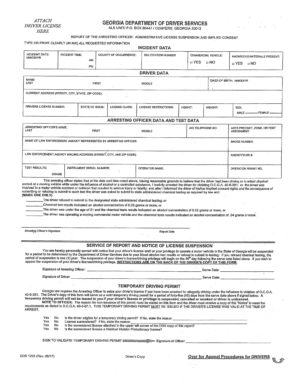
Besides your Georgia DUI case pending in Court, you are likely facing an administrative license suspension – a separate action from your Driving Under the Influence criminal charges. Unfortunately, there is little time to request a hearing regarding this license suspension action (30 days from the date of your DUI arrest). The hearing is conducted through the Office of State Administrative Hearings. The officer likely served you a license suspension notice if you were charged with a DUI in Georgia. If you were arrested by a DUI task force officer or a Georgia State Patrol Trooper, you can be sure that you were served with a notice of a license suspension action. Whether you refused the State’s chemical test or the breath test results indicated an alcohol concentration above the legal limit, Georgia law requires your officer to notify you of a license suspension. This notice is commonly referred to as a DDS-1205 form, as indicated on the bottom left corner of the form. The top of the form will say “Georgia Department of Driver Services.” This form is either yellow or white; the officer may have had you sign it. Officers sometimes explain that this form acts as a temporary driving permit but never explain that it also serves as a notice that the officer has initiated a license suspension action against you. Sometimes, this form gets lost (you may have received it, but it may have been misplaced or lost at the jail).
- We strongly suggest that you set up an online account with the Georgia Department of Driver Services to monitor the status of your driver’s license
Regardless of whether you have received a DDS-1205 form, you must understand that you have only 30 days to request a hearing to preserve your driving privileges or waive your hearing by opting for an ignition interlock device permit through the Georgia Department of Driver Services.
Three tracks you can take [beware of choosing without the advice of an experienced DUI lawyer]:
-
Do nothing within 30 days of the date of your Georgia DUI arrest:
In most cases, we do not recommend doing nothing within 30 days of your arrest date for a Georgia DUI. Suppose you take no action within 30 days of your arrest, and your officer initiates an administrative license suspension action. In that case, the Georgia Department of Driver Services will automatically suspend your driving privileges on the 46th day after your arrest. Even if you did not receive the DDS-1205 form, we recommend taking some action instead of doing nothing. However, there are limited circumstances in which our criminal defense attorneys advise our clients to take no action, but these circumstances are rare.
-
Request an administrative hearing in your DUI case in Georgia:
The traditional track, which has been the law for many years, is to request an administrative hearing. However, there are now thirty days instead of ten business days to submit a request for a hearing. This track is where a request for an administrative hearing is submitted to the Georgia Department of Driver Services (along with a $150 processing fee) challenging your Georgia DUI officer’s decision to administratively suspend your driver’s license for testing above Georgia’s “per se” legal limit for alcohol concentration, or for refusing the officer’s request for a state-administered chemical test.
-
Properly waive your right to an administrative license suspension hearing and have an ignition interlock installed:
This track came into effect on July 1, 2017. Suppose this is your first DUI arrest in five years. In that case, you can adequately waive your right to an administrative hearing, install an ignition interlock device, and apply for a limited permit. This will enable you to drive in Georgia and fight your Georgia DUI criminal case without risking the loss of your driving privileges. It comes with a cost, of course. It involves you waiving your right to an administrative hearing through the Georgia Department of Driver Services. You will need to install an ignition interlock device on your vehicle by a certified ignition interlock provider for a minimum of 120 days if you tested over the “per se” legal limit, or you will be required to undergo one year of having the ignition interlock device installed in your vehicle (and driving under the terms of an ignition interlock permit) if you refuse the officer’s request for a state-administered chemical test. If you choose this track, we highly recommend installing the ignition interlock device first and visiting the DDS within 30 days of the arrest date to obtain the permit. There are obvious concerns and pitfalls in choosing this track. For many, the stigma of having the ignition interlock device installed in their vehicle is not worth it. The ignition interlock device is expensive, requiring installation and monthly monitoring fees. Suppose you remove it while under your ignition interlock permit, tamper with it, or it tests positive for alcohol. In that case, your permit to drive may be revoked for six months, which means you will be prohibited from driving altogether. In addition to waiving your right to an administrative hearing and having an ignition interlock device installed on your vehicle, you must also meet the following conditions:
- The application for the permit must be made with DDS within 30 days of the person being served notice of the ALS by your Georgia DUI arresting officer through the DDS-1205 form, or—in the event of a DDS-1205S form—within 30 days of receiving such notice of the ALS from DDS;
- The ALS cannot stem from a motor vehicle accident involving fatalities or serious injuries;
- The person must be licensed in Georgia and not have any other suspensions, cancellations, or revocations against their Georgia driver’s license;
- If the person holds a Georgia commercial driver’s license (CDL), they must downgrade to a non-commercial Georgia driver’s license to obtain and maintain the permit;
- A driver cannot have any prior convictions for DUI in the 5 years preceding application for the permit;
- The person must surrender their Georgia driver’s license, either to the arresting officer at the time of arrest or to DDS before issuance of the permit; and,
- There is a $25.00 ignition interlock permit fee.
The period during which a person must successfully maintain the ignition interlock device on their vehicle will depend on whether they consent to or refuse the state-administered chemical test requested by their arresting officer.
A person who consents to the state-administered chemical test and opts for the new permit will be required to successfully maintain the ignition interlock device on their vehicle for a period of four months. If they are subsequently acquitted of the underlying Georgia DUI charge or the underlying DUI charge is dismissed or reduced, the ignition interlock device may be removed at no cost, and the driver’s license may be replaced. A person who refuses the state-administered chemical test and opts for the new permit will be required to successfully maintain the ignition interlock device on their vehicle for 12 months, regardless of the outcome of the underlying Georgia DUI charge.
The successful maintenance of the ignition interlock device must be demonstrated by the permit holder to the Department of Driver Services (DDS) through the production of satisfactory monthly monitoring reports before DDS removes the ignition interlock restriction from the permit. A permit may be renewed for a fee of $5.00 if additional time is needed for the permit holder to comply with the terms of the ignition interlock device. Still, it may only be renewed one time once the permit holder becomes eligible to reinstate their driver’s license. Following the designated term of successful compliance, the ignition interlock device restriction may be removed from the limited driving permit in person at a DDS Customer Service Center for a fee of $100.00 (or $90.00 if removal of the restriction is requested by mail or other approved alternate means). The removal fee is in addition to any reinstatement fee that may be required.
Our criminal defense attorneys can further explain the benefits and pitfalls of installing an ignition interlock device and getting an ignition interlock permit.
A warning to Georgia drivers:
Every Summer, the Georgia State Patrol nighthawks DUI Task Force and almost every other law enforcement agency in Georgia will enforce the 100 Days of Summer H.E.A.T. campaign from May 19 through Labor Day, September 7. The Click It or Ticket campaign ran from May 18 through May 31 and will again run over the Thanksgiving holiday. Operation Zero Tolerance ran from June 29 through the Fourth of July weekend. The Drive Sober or Get Pulled Over campaign will run from August 19 through Labor Day, and again mid-December campaign through New Year’s Day. Local law enforcement H.E.A.T. units, such as the Atlanta Police Department, participate in all sober driving mobilization campaigns. We continue to see a concentrated effort for DUI detection, including roadblocks (checkpoints) during major sporting events, concerts, and holidays.
The Governor’s Office of Highway Safety (GOHS) and the National Highway Traffic Safety Administration (NHTSA) consistently issue warnings about the dangers of impaired driving and encourage the designation of a sober driver. Here is a recent social media post from Georgia GOHS on Facebook, emphasizing folks to drive sober or get pulled over.
Call our experienced DUI attorneys today:
The experienced Atlanta-based DUI attorneys at Chestney & Sullivan will vigorously investigate and defend every aspect of your arrest. If something provides grounds for reasonable doubt of your guilt, we will find it. And our criminal defense attorneys are prepared to go as far as necessary within Georgia law to protect your rights. Suppose you are facing serious DUI or vehicular homicide charges in Atlanta, Fulton County, DeKalb County, Cobb County, Cherokee County, Forsyth County, Gwinnett County, or anywhere else in Georgia. In that case, you deserve the best defense available. Contact Chestney & Sullivan today at 404.816.8777.
More information about what we do:
Administrative License Suspension
Map of Chestney & Sullivan Law Firm address: